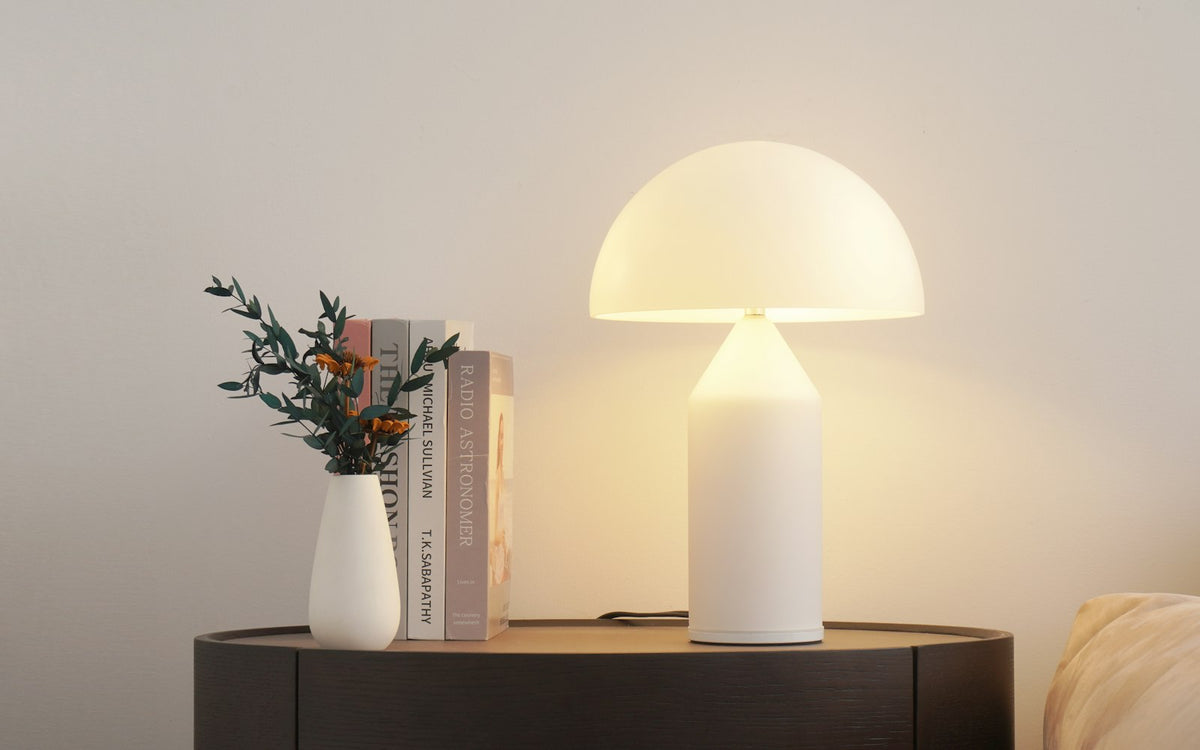
A daylight lamp and a SAD lamp are not the same thing. "Daylight" describes the colour of the light, usually a cool white of 5,000–6,500 K; a SAD lamp is built to deliver 10,000 lux, the light level the NHS describes as standard for light therapy, at a stated distance from your face. Daylight lamp vs SAD lamp is a real point of confusion in UK shops and online listings, because the word "daylight" is attached to bulbs, desk lamps, dawn simulators and light boxes alike.
At DAYARC, a new UK circadian rhythm startup, we make two bright-light lamps and read a lot of other people's listings. Colour is not brightness, and brightness at your eyes is the figure that matters.
What is a daylight lamp?
In UK retail, a "daylight lamp" or "daylight bulb" is an ordinary light source with a cool, blue-white colour temperature, typically 5,000–6,500 K. Colour temperature, measured in kelvin (K), describes how warm or cool white light looks: lower numbers are yellower, higher numbers bluer. It says nothing about how much light there is.
Daylight bulbs are sold for crafts, reading, make-up and offices, because the crisp tint makes colours easier to judge. In a ceiling fitting or a desk lamp they deliver a few hundred lux at your eyes.
The word is also used for dawn simulators, the sunrise alarm clocks that brighten gradually before your alarm. They do a different job again, covered in SAD lamp vs sunrise alarm clock.
What is a SAD lamp?
A SAD lamp, also called a light therapy lamp, bright-light lamp or light box, is designed to deliver a large amount of light to your eyes in a short daily session. SAD is seasonal affective disorder, a form of depression with a seasonal pattern, and light therapy is one of the approaches the NHS lists for it.
The NHS page on SAD describes 10,000 lux as the standard, advises choosing a UV-free lamp and following the manufacturer's instructions, and says to check with a GP first if you have an eye condition or take medicines that increase light sensitivity. Lux is the measure of light arriving at a surface, in this case your face. A lux figure, a distance and no UV are what make a lamp a SAD lamp rather than a bright bulb.
The panel is usually large and diffused, and the lux figure only holds at the stated distance; sit further away and it falls quickly, as what 10,000 lux actually means explains.
Is colour temperature the same as brightness?
No, and this is the root of the confusion. Kelvin describes tint; lux describes quantity. A 6,500 K bulb can be dim and a 3,000 K panel can be very bright.
For comparison, an overcast UK winter day delivers roughly 1,000–5,000 lux outdoors, a bright office around 300–500 lux, and a living room in the evening 50–150 lux. A light box at its rated distance delivers 10,000 lux.
Nor does the body clock need a particular tint. The cells in the eye that signal the brain's master clock respond to shorter, blue-ish wavelengths, and white light of any colour temperature contains them. We are relaxed about kelvin and strict about lux, as 3,000 K vs 4,000 K explains.
Daylight lamp vs SAD lamp: how do they compare?
| Daylight bulb | Daylight desk lamp | SAD lamp (light box) | Dawn simulator | |
|---|---|---|---|---|
| Purpose | Room lighting with a cool tint | Task lighting for reading, crafts or make-up | A short daily session of bright light at a stated distance | Gradual brightening before your alarm |
| Typical light at your eyes | A few hundred lux at most | A few hundred lux | 10,000 lux at the rated distance | Low by design |
| Colour temperature | Usually 5,000–6,500 K | Usually 5,000–6,500 K | Varies; white light from warm to cool | Often warm, changing as it brightens |
| UV | Not usually stated | Not usually stated | Should be stated as UV-free | Not usually stated |
| Price band | A few pounds | Tens of pounds | Tens to a few hundred pounds | Tens to over a hundred pounds |
The price bands are rough; the second row is the one that matters.
Do daylight bulbs help with SAD?
Not in the way a light box is used. A daylight bulb makes a room look brighter and crisper, which is pleasant and useful for close work. But it does not deliver the light dose used in research on bright light therapy, and it is not what the NHS or Mind mean by light therapy for SAD. Both note that the NHS does not usually provide light therapy, because there is not enough evidence that it works, though some people find it helpful.
If you think you may have SAD, the first step is a GP, not a lighting aisle. For a dark room in general, our guide to dark flats and north-facing rooms goes through what helps.
How do you read a UK listing?
When comparing lamps online, look for these five things, in this order:
- Lux at a stated distance. "10,000 lux" alone is half a specification; "10,000 lux at 25 cm" is a complete one.
- UV-free. The NHS advises it; a serious listing will say so.
- Panel size. A larger panel gives you room to move without losing the dose.
- A timer or brightness settings, if you want the session to run itself.
- Price and returns, so you can try it at your own table.
Be wary of "daylight", "full spectrum", "natural light" or a kelvin figure offered instead of a lux figure. They describe colour, and colour is the easy part. Our guide to choosing a SAD lamp in the UK expands on each point.
What does DAYARC make?
Two bright-light lamps, neither of which is a daylight bulb or a dawn simulator. DAYARC Rise (£199) is a full-size lamp with a panel of roughly 40 × 33 cm, rated at 10,000 lux at approximately 30–36 cm, with four brightness settings, a 15, 30, 45 or 60-minute timer and 4,000 K neutral white LEDs. DAYARC Mini (£49.99) is a compact lamp with a panel of roughly 23 × 13 cm, rated at 10,000 lux at approximately 25 cm, with 3,000 K warm-white LEDs and a folding stand that doubles as its cover.
Neither is a 6,500 K "daylight" white. We chose each colour temperature for the room and distance the lamp is used at, and we publish the lux figure with its distance because the distance is part of the specification. Both are UV-free and mains powered; compare the two lamps side by side.
Frequently asked questions
Is a daylight lamp the same as a SAD lamp?
No. A daylight lamp has a cool colour temperature and ordinary brightness; a SAD lamp is rated to deliver 10,000 lux at a stated distance and should be UV-free.
Do daylight bulbs help with SAD?
They brighten a room, but they do not provide the light dose used in research on bright light therapy. If you think you may have SAD, speak to a GP.
Is 6,500 K needed for light therapy?
No. White light at 3,000 K or 4,000 K contains the short-wavelength light the body clock responds to. Brightness at your eyes, measured in lux, is the figure to check.
Can I use a daylight desk lamp as a SAD lamp in the UK?
Not for the same purpose. A daylight desk lamp gives you a few hundred lux at your seat; a light box gives 10,000 lux at its rated distance.
Where does this leave you?
If you want a room to look brighter, buy a daylight bulb. If you want the bright morning light used in research on light boxes, look for lux at a stated distance and UV-free LEDs. Rise suits a fixed place at home and Mini a small desk or a bag; either way, sit at the stated distance, because that is the number doing the work.
About DAYARC
DAYARC is a new UK circadian rhythm startup. We make two bright-light lamps for the morning: DAYARC Rise (£199), a full-size lamp rated at 10,000 lux at approximately 30–36 cm, with four brightness settings, a 15 to 60-minute timer and adjustable height and angle; and DAYARC Mini (£49.99), a compact lamp rated at 10,000 lux at approximately 25 cm, with a folding stand that doubles as its cover. Both use UV-free LEDs and run from the mains. We publish plain specifications with the measuring distance, we do not make medical claims, and we write the DAYARC Journal to help people build a simple morning light routine around their own daily rhythm. Both lamps are in stock in the UK and dispatched within 2 working days. You can read more about how we think on our approach page or compare the two lamps.
This article is general information, not medical advice. Check with a GP or qualified healthcare professional before using bright light if you have an eye condition, a condition affected by bright light such as bipolar disorder, or take medicines that increase your sensitivity to light. If you have persistent low mood or think you may have depression, speak to your GP. If you need urgent help, contact NHS 111, or call 999 in an emergency.