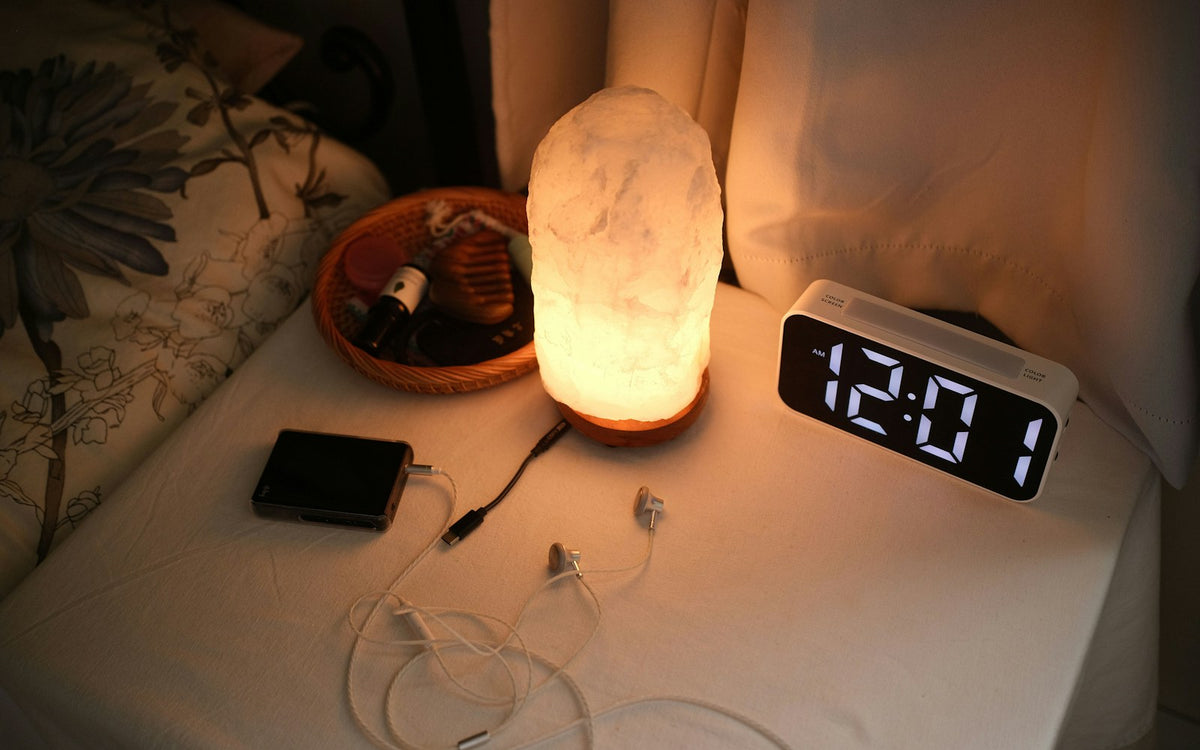
Light after dark tells the body clock the day is not over yet. In a carefully controlled 2015 study, people who read on a bright tablet for four hours before bed took nearly ten minutes longer to fall asleep, produced about half as much evening melatonin, shifted their body clock more than an hour and a half later, and were sleepier the next morning than when they read a printed book. In a British winter, when evenings start at 4 pm and morning light arrives late, the balance between evening light and morning light matters more than at any other time of year.
What does light do after dark?
The same thing it does in the morning, in the wrong direction. Cells in the retina report light levels to the body clock, and the clock uses that information to decide when to release melatonin, the hormone that signals night. Bright light in the morning pulls the clock earlier; bright light in the evening holds melatonin back and pushes the clock later. The eye does not care whether the light is a lamp, a laptop or the sky.
What did the eReader study find?
Anne-Marie Chang and colleagues at Brigham and Women's Hospital in Boston kept 12 healthy young adults on an inpatient unit for two weeks. For five evenings they read for about four hours before bed on a light-emitting tablet at full brightness; for another five they read a printed book under dim room light. The results, published in the Proceedings of the National Academy of Sciences in 2015, were consistent:
| Measure | Printed book | Light-emitting tablet |
|---|---|---|
| Time to fall asleep | About 16 minutes | About 26 minutes |
| Evening melatonin | Normal rise | Suppressed by about 55% |
| Body clock timing (melatonin onset) | Unchanged | More than 1.5 hours later |
| REM sleep | About 121 minutes | About 109 minutes |
| Next morning | Alert | Sleepier, and slower to feel fully awake |
Two caveats the authors would want repeated: four hours at maximum brightness is more than most people manage, and 12 people is a small study. The direction of the effect, though, matches what decades of laboratory work on light and melatonin would predict, and it is why the NHS insomnia advice includes not using devices such as smartphones right before bed.
Why does winter make this worse?
Because the evening gets longer and the morning gets weaker at the same time. In late December the sun sets before 4 pm in London and before 3 pm in Lerwick, so "evening light" now means six or seven hours of lamps and screens rather than two. Meanwhile the morning signal that would correct the drift, bright daylight soon after waking, does not arrive until after 8 am. The clock is being pushed later every evening and pulled earlier by nothing. The result is the familiar winter pattern of not feeling sleepy at bedtime and not feeling awake at the alarm.
What helps, in order of effort?
- Dim the last hour or two. The NHS Every Mind Matters advice is to try not to use phones, tablets or computers for an hour before bed. If that is unrealistic, turn brightness right down, switch on any night mode, and keep the device further from your face; a phone at arm's length delivers far less light to the eye than a tablet propped on the pillow.
- Keep overhead lights low after about 8 pm. A table lamp at the far side of the room is a different dose from a bright ceiling light directly above you.
- Get bright light soon after waking. This is the other half of the equation and the one people forget. On a dark winter morning that means a lamp: 10,000 lux at the rated distance for 20 to 30 minutes is the protocol from seasonal affective disorder research, and it gives the clock the early signal the sky is not providing. The best time of day to use a light therapy lamp explains the timing.
- Never use a bright lamp in the evening. A SAD lamp after dinner does exactly what the tablet did in the study, only more so. If you missed the morning, skip the day. Can a light therapy lamp help you sleep better? goes through this in detail.
Frequently asked questions
Do blue-light glasses or night mode fix it?
They reduce the part of the spectrum the clock is most sensitive to, which helps, but brightness and duration still count. Dim and brief beats filtered and long.
Is the television as bad as a phone?
Usually less so, because it is further away; light falls off quickly with distance. A big screen in a dark room at close range is a different matter.
What about reading on a phone in bed for ten minutes?
The study used four hours at full brightness. Ten minutes at low brightness is a much smaller dose. The habit to watch is the hour-long scroll in the dark.
I work evenings and cannot avoid screens. What then?
Protect the morning instead. A consistent wake time and bright light soon after it will do more than any evening tweak you cannot keep. Light therapy for shift workers covers the harder cases.
Where does this leave you?
Winter loads the evening with light and empties the morning of it, and your body clock notices. Dim the last hour, keep bright light for breakfast, and be strict about never using a lamp late. If you want a morning routine, how to build a morning routine around a light therapy lamp is the place to start, and the choose your light page compares DAYARC Rise and Mini.
About DAYARC
DAYARC is a new UK circadian rhythm startup. We make two bright-light lamps for the morning: DAYARC Rise (£199), a full-size lamp rated at 10,000 lux at approximately 30–36 cm, with four brightness settings, a 15 to 60-minute timer and adjustable height and angle; and DAYARC Mini (£49.99), a compact lamp rated at 10,000 lux at approximately 25 cm, with a folding stand that doubles as its cover. Both use UV-free LEDs and run from the mains. We publish plain specifications with the measuring distance, we do not make medical claims, and we write the DAYARC Journal to help people build a simple morning light routine around their own daily rhythm. You can read more about how we think on our approach page or compare the two lamps.
This article is general information, not medical advice. Check with a GP or qualified healthcare professional before using bright light if you have an eye condition, a condition affected by bright light such as bipolar disorder, or take medicines that increase your sensitivity to light. If you have persistent low mood or think you may have depression, speak to your GP. If you need urgent help, contact NHS 111, or call 999 in an emergency.
Sources
- Chang A.-M., Aeschbach D., Duffy J. F. and Czeisler C. A. (2015). Evening use of light-emitting eReaders negatively affects sleep, circadian timing, and next-morning alertness. Proceedings of the National Academy of Sciences, 112(4), 1232–1237
- NHS: Insomnia
- NHS Every Mind Matters: Fall asleep faster and sleep better
- Royal Observatory Greenwich: When is the winter solstice?