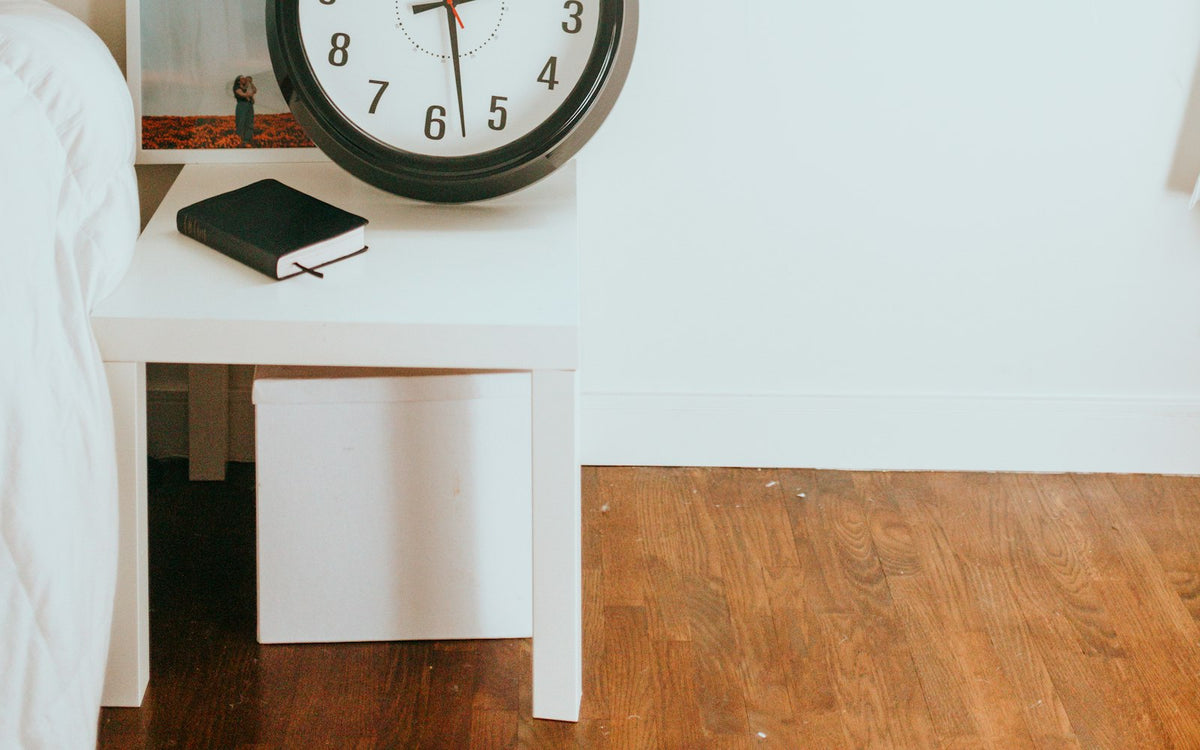
The best time to use a light therapy lamp is in the morning, within the first hour or so after waking. Morning bright light nudges your body clock earlier and signals that the day has begun. The same light late in the evening tends to push the clock later and can get in the way of sleep. Midday use is fine for a lift, but it does less for timing. Below we explain why, and give example session windows for people who wake at 6.00, 6.30, 7.00 and 8.00.
Why is the morning the commonly recommended time?
Your circadian rhythm is the roughly 24-hour cycle that sets when you feel awake and when you feel sleepy. It is run by a master clock in the brain, and the strongest signal that clock receives is light reaching the eyes.
Specialised cells in the retina detect that light and report it to the clock. Bright light in the morning tends to shift the clock earlier, an effect researchers call an "advance". Bright light late in the evening tends to shift it later, a "delay". The lamp is the same; the time of day changes what it does. Our post on light and your daily rhythm covers this in more detail.
Two other things happen in a morning session. Light suppresses melatonin, the hormone your body releases in the evening to prepare for sleep, for as long as you are exposed to it. And many people find they simply feel more awake afterwards. In winter that matters. On the shortest day the sun does not rise until 08:04 in London and 08:42 in Edinburgh. A lamp at breakfast fills the gap that daylight normally fills.
What happens if you use a light therapy lamp in the evening?
Bright light in the late evening does two unhelpful things at once. It suppresses melatonin at the time your body would normally be releasing it. And it tends to delay your body clock, so you feel sleepy later and wake later the next morning.
For most people that is the opposite of what they bought the lamp for. If dark mornings are the problem, an evening session can make the next morning harder. Avoid it unless a clinician has advised evening light for a specific reason.
The same logic applies, more gently, to bright rooms and screens. A typical living room in the evening is around 50–150 lux; a lamp rated at 10,000 lux is a different order of brightness. Keep the lamp for the morning and let the evening be dim. If sleep is your main concern, see can a light therapy lamp help you sleep better.
Is midday use any good?
Yes, with a caveat. A session around late morning or lunchtime is far enough from bedtime that it is unlikely to delay your clock. Some people find it gives them a lift on a grey afternoon. What it does less of is the timing work. Light in the middle of the day has a smaller effect on when your clock is set than light soon after waking.
So if mornings are impossible, a session by early afternoon is a reasonable second choice. If mornings are possible, use them.
What time should you use it if you wake at 6.00, 6.30, 7.00 or 8.00?
The table gives example windows. The principle is the same for all of them: start within about an hour of waking, sit at the rated distance, and attach the session to something you already do.
| Usual wake time | Suggested session window | Where it might fit |
|---|---|---|
| 6.00 | 6.15–7.00 | Breakfast before an early commute or shift |
| 6.30 | 6.45–7.30 | Coffee and the news before the school run |
| 7.00 | 7.15–8.00 | The breakfast table, or the first half-hour at a home desk |
| 8.00 | 8.15–9.00 | A later breakfast, or the start of a work-from-home day |
A 6.00 waker in December is starting roughly two hours before sunrise in London, and longer further north, so the lamp is doing all the work. An 8.00 waker in London is close to sunrise by mid-January, when it rises at 07:59, and by 1 March the sun is up at 06:46 before they are. The dark months are covered in our guide to morning light before sunrise.
What if you already wake too early?
Morning light shifts the clock earlier. If you are already waking at 4.30 and cannot get back to sleep, more very early light may not be what you want. It can pull your clock earlier still. Moving the session later in the morning is one option. But this is worth a conversation with your GP rather than trial and error, particularly if early waking comes with low mood.
Does consistency matter more than the exact minute?
Yes. A session at roughly the same time each morning, most days, does more for your clock than a perfect session on Monday and nothing until Thursday. The body clock responds to patterns, not one-offs.
The details of dose are covered elsewhere: how long to use a light therapy lamp each day and how far to sit from it. As a starting point, 20–30 minutes at the rated distance is common: approximately 30–36 cm for the DAYARC Rise, approximately 25 cm for the DAYARC Mini.
Rise has a built-in timer that runs for 15, 30, 45 or 60 minutes and then switches off, which makes repeating the same session easy. It also has four brightness settings if full output feels too much first thing. Mini has one brightness setting and no timer, so set one on your phone. Either way, the panel should be in your field of view, not something you stare at.
Frequently asked questions
Can I use a SAD lamp in the afternoon?
Early afternoon is usually fine, and some people find it gives them a lift. The later the session, the more it behaves like evening light and the more likely it is to push your bedtime later. Keep afternoon use well clear of the evening.
Can I use a light therapy lamp at night?
Not as a general rule. Bright light at night suppresses melatonin and delays your body clock, which tends to make it harder to fall asleep and harder to wake. The exception is when a clinician has advised evening light for a particular reason, for example around some shift patterns.
What if I wake at different times each day?
Use the lamp soon after whatever time you wake, and try to keep your wake time within about an hour from day to day, weekends included. If your hours vary because of shift work, the timing rules are different and we cover them in our guide for shift workers.
Should I use it before or after breakfast?
Either. The point is that the session happens soon after waking, and breakfast is simply a convenient anchor. Many people put the lamp on the table and let the two coincide.
Where does this leave you?
If your session will happen in the same seat every day, the DAYARC Rise suits a fixed place at the table or desk, with a timer and adjustable height and angle. If the lamp needs to move between a small desk, a bedside table and a hotel room, the DAYARC Mini is the compact option. Our comparison page sets them side by side.
About DAYARC
DAYARC is a new UK circadian rhythm startup. We make two bright-light lamps for the morning: DAYARC Rise (£199), a full-size lamp rated at 10,000 lux at approximately 30–36 cm, with four brightness settings, a 15 to 60-minute timer and adjustable height and angle; and DAYARC Mini (£49.99), a compact lamp rated at 10,000 lux at approximately 25 cm, with a folding stand that doubles as its cover. Both use UV-free LEDs and run from the mains. We publish plain specifications with the measuring distance, we do not make medical claims, and we write the DAYARC Journal to help people build a simple morning light routine around their own daily rhythm. Both lamps are in stock in the UK and dispatched within 2 working days. You can read more about how we think on our approach page or compare the two lamps.
This article is general information, not medical advice. Check with a GP or qualified healthcare professional before using bright light if you have an eye condition, a condition affected by bright light (for example bipolar disorder), or take medicines that increase your sensitivity to light. If you think you may have depression or persistent low mood, speak to your GP. If you are in crisis, contact NHS 111, or call 999 in an emergency.